Referral Intelligence
Making referral management visible.
The problem
Businesses that depend on referrals often know referrals matter but can't see which relationships actually generate results. The information sits across spreadsheets, emails and individual memory, so it's hard to measure performance or spot the partnerships worth protecting.
I built this for exactly that situation — a specialist clinic whose growth runs on referrals from partner practices.
Research
I don't work in healthcare, so I did what I do in every domain: I worked with someone who lives the problem — a business-development manager at a specialist clinic whose job is those referral relationships. They brought the questions a BD manager actually asks every week:
- Where are our referrals coming from?
- Which partners generate the most treatments?
- Which referral sources are going quiet?
- Where should we invest more time?
None of those are answered by a longer list. The biggest problem wasn't collecting referrals.
It was understanding them.
The design approach
I designed Refer Your Patient as a referral intelligence product, not a database — turning scattered referral activity into a picture you can act on:
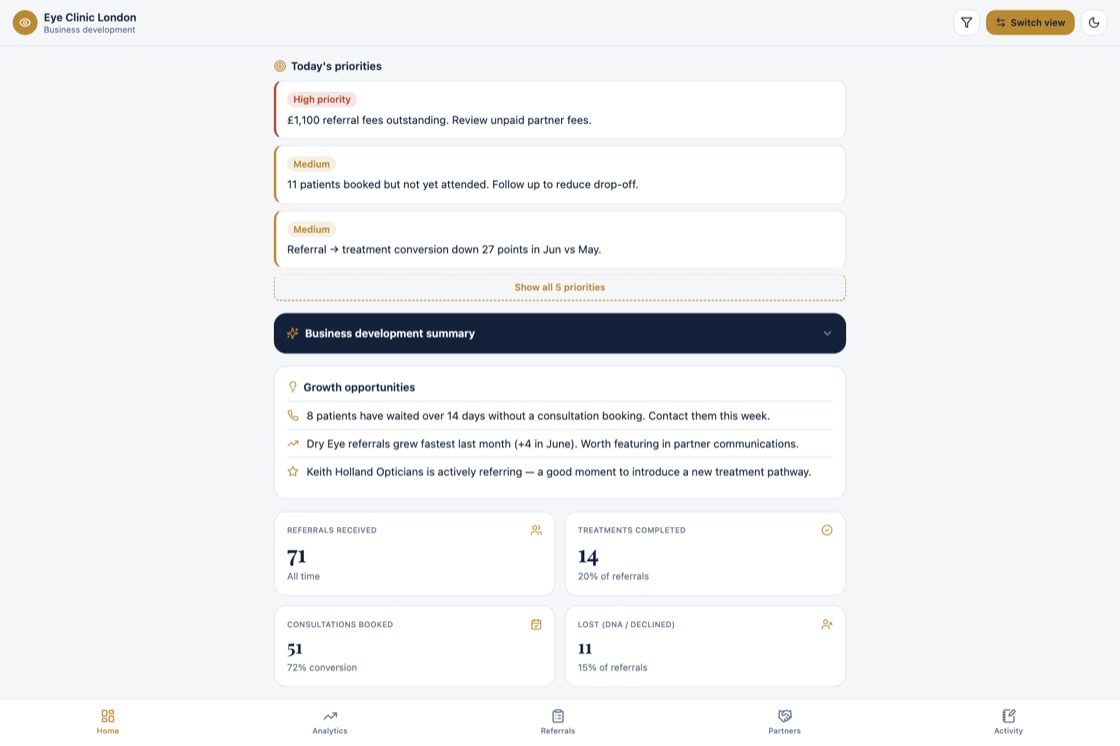
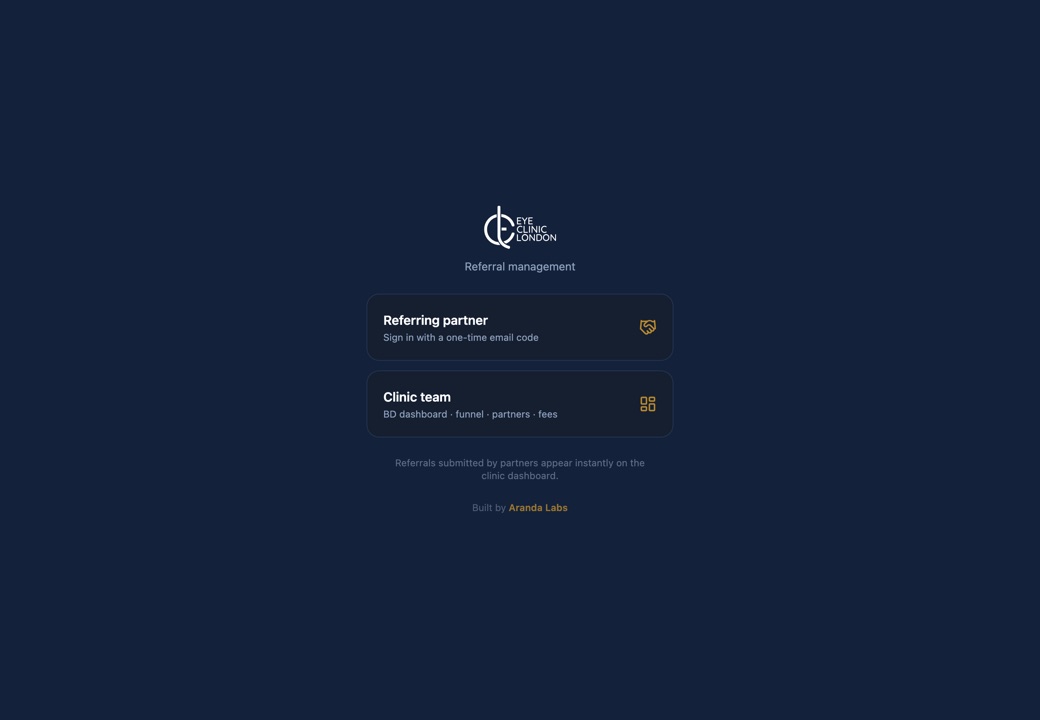
Two connected experiences meet at the referral: a partner refers in a few taps; the clinic sees it as funnel, partners and fees.
The decisions behind it:
Two roles, joined at the moment of intent
A referring partner and the clinic team are different users with different jobs, so there are two connected experiences that meet at the moment a referral is made. It models a relationship, not a form.
An insights engine, not just charts
A dashboard's job is to tell you what to do. Alongside the funnel, it surfaces prompts in plain English — "this partner hasn't referred in over a month, schedule a visit," "these fees are outstanding," "this source is your highest converter." Numbers become decisions.
Make the money concrete
Referral activity is tied to per-treatment fees, what's owed versus paid per partner, and each partner's contribution — because the thing a practice owner actually cares about is which relationships are worth the time.
Technical implementation
A polished single-page app that models the whole two-sided system on the front end with seeded data — the engineering exists to make referral activity understandable, not just stored.
The decisions that mattered technically:
Model the whole two-sided system in the browser
Rather than wait for a backend, I built the complete experience — partner and clinic — against one shared data model on the front end, so a referral flows straight to the clinic view without re-keying. It proves the two-sided interaction end to end before a line of server code exists.
Passwordless by design
The production design signs partners in with a one-time email code, not a password — less friction for a busy practice, one fewer credential to protect. It's a sensible default for anything that will touch healthcare data; the demo lets any code through so it's easy to explore.
A seeded, deterministic surface
All data is fake and stable, so the product demonstrates identically every time and never touches real patient records. It shows the thinking, safely.
Outcome
Refer Your Patient is live at referyourpatient.co.uk, running on seeded demo data so it can be shown safely. It reframes referral management from a list you store into a picture you can act on — which relationships to protect, which to chase, and where the next visit is worth making.
What I learned
Working on this project reinforced that good software doesn't just store information — it helps people understand it.
The value comes from turning data into decisions.
The dashboard shows illustrative demo data only — no real patient details are used.