Independent product studio West London Est. built around full-time work & family

I notice problems, speak to the people living them, and build better ways forward.

I'm Alan Aranda — a self-taught product builder and Royal Mail postman. Each product started somewhere real: as a parent, a postman, a customer, or a conversation with someone trying to do their job better. Then I turned it into something that works.

Data centres → DC Translator Parent → LITTLElocals Clinics → Referral Tracker Trades → OHNAR Postal → Walk Coach
01Infrastructure · Feasibility tool

DC Requirements Translator

Turn hyperscaler requirements into civil design impacts, build-risk notes and side-by-side density scenarios.

A hyperscaler's tenant requirements — rack density, power redundancy, cooling — don't obviously translate into what they mean for the civil and structural design. Working that out early is slow, manual and easy to get wrong.

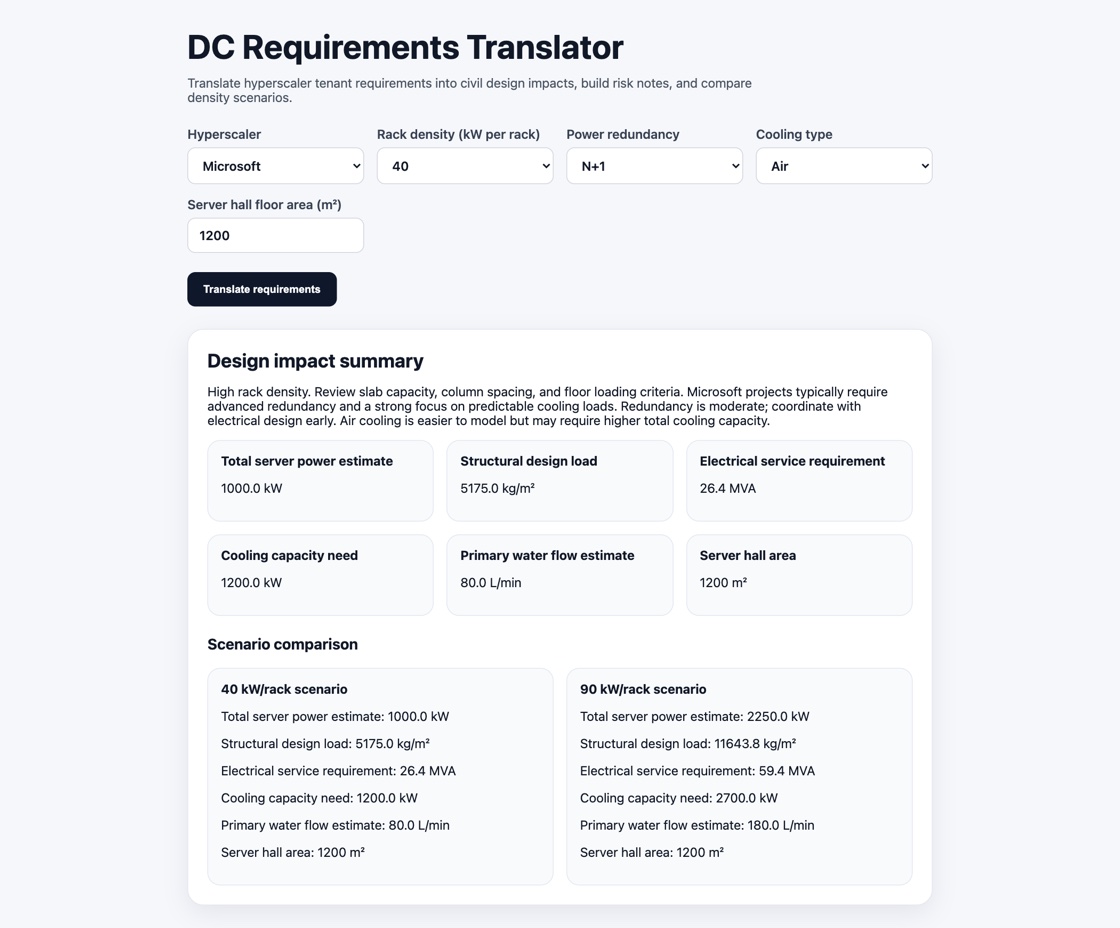
Built from a conversation with a data-centre engineer, it turns those inputs — hyperscaler, kW per rack, N / N+1 / 2N redundancy, air or liquid cooling, floor area — into a design-impact summary: structural load, electrical service, cooling capacity and water flow, with a side-by-side comparison of density scenarios.

It's an early MVP for testing feasibility on current and future projects — a specialist tool for a specialist problem.

What it took
Domain translationRequirements modelling Feasibility analysisScenario comparison
DC Requirements Translator
The DC Requirements Translator showing a design-impact summary — structural load, electrical service, cooling and water flow — and a 40 versus 90 kW per rack scenario comparison
02Marketplace · Discovery

LITTLElocals

One place to find things to do with your kids — filtered by age, day, weather, cost and distance.

As a father of two young children, finding a good local activity meant stitching together social-media pages, outdated websites, posters and WhatsApp groups — with no reliable way to know what was actually running today.

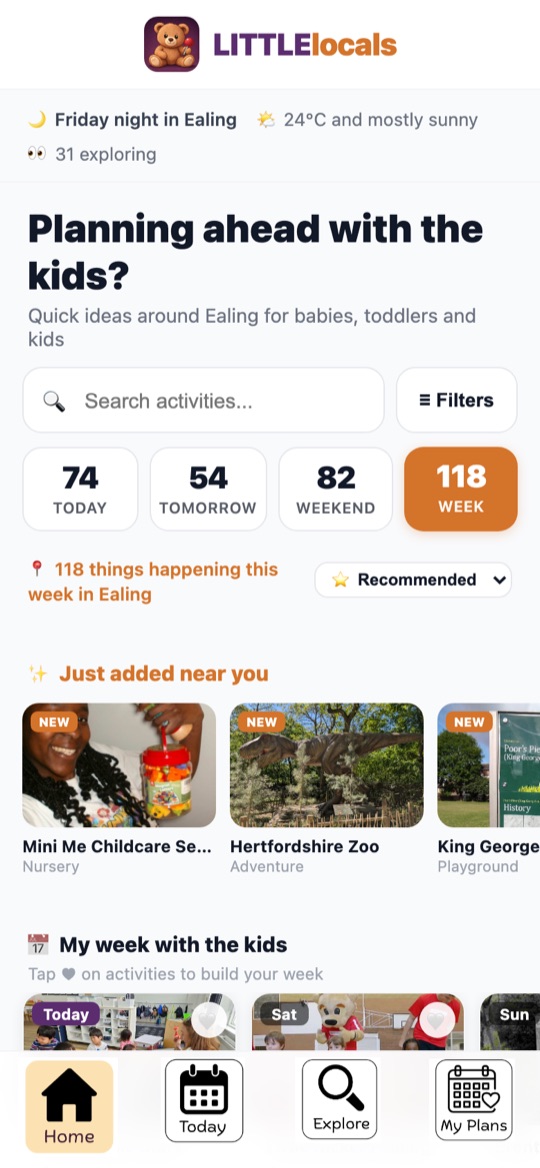
LITTLElocals pulls it into one searchable local product: Today, Weekend and Week views, age and type filters, a full-screen activity map, saved plans, provider profiles with claim tools, reviews, verified badges and SEO-friendly pages for every activity.

It grew to more than 1,000 users in its early launch period, listing hundreds of activities and building real relationships with providers and parents across Ealing.

What it took
Discovery UXProvider onboarding User-generated contentTrust & verification Local SEOMaps & filtering
LITTLElocals on a phone, showing this week's activities across Ealing with day filters and a plan builder
littlelocals.uk
03Business intelligence · CRM

Referral & BD Tracker

See where referrals really come from — and what they turn into.

Counting referrals isn't enough. A business needs to know the source and the referrer, whether the consultation happened, what was recommended and delivered, and the outcome — so it can tell which relationships actually pay off.

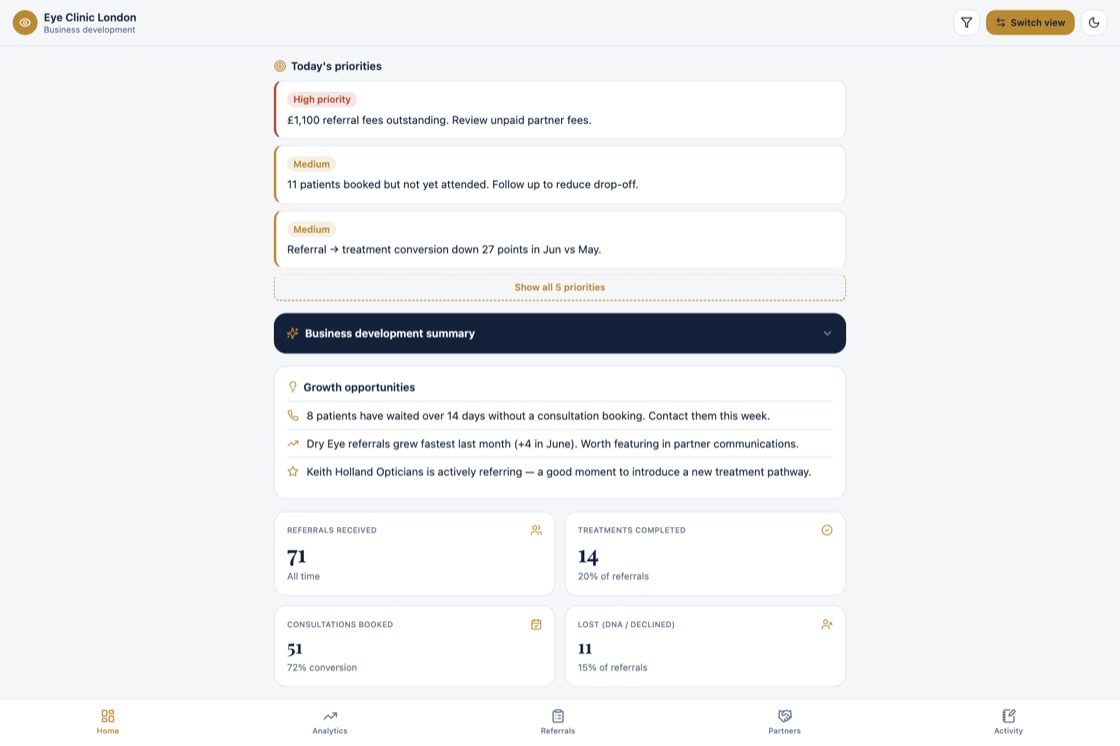
It tracks the full funnel — referral received, source, referrer, consultation booked and attended, treatment recommended and completed, outcome and revenue — with conversion rates, monthly performance and source comparison.

It came from speaking to professionals who could see their referral numbers but not which sources and relationships were worth the effort.

What it took
Funnel analysisKPI design DashboardsStakeholder discovery
referyourpatient.co.uk
The referyourpatient clinic dashboard showing a patient-journey funnel, referral and conversion KPIs, and today's priorities, with demo data
Demo data — no real patient details are shown
04SaaS · Mobile-first

OHNAR

Quote in seconds, invoice from your phone, and see what you actually made.

Most self-employed tradespeople run work across paper, WhatsApp, memory and spreadsheets. The tools that exist are too complex, too expensive, or built for accountants and bigger firms.

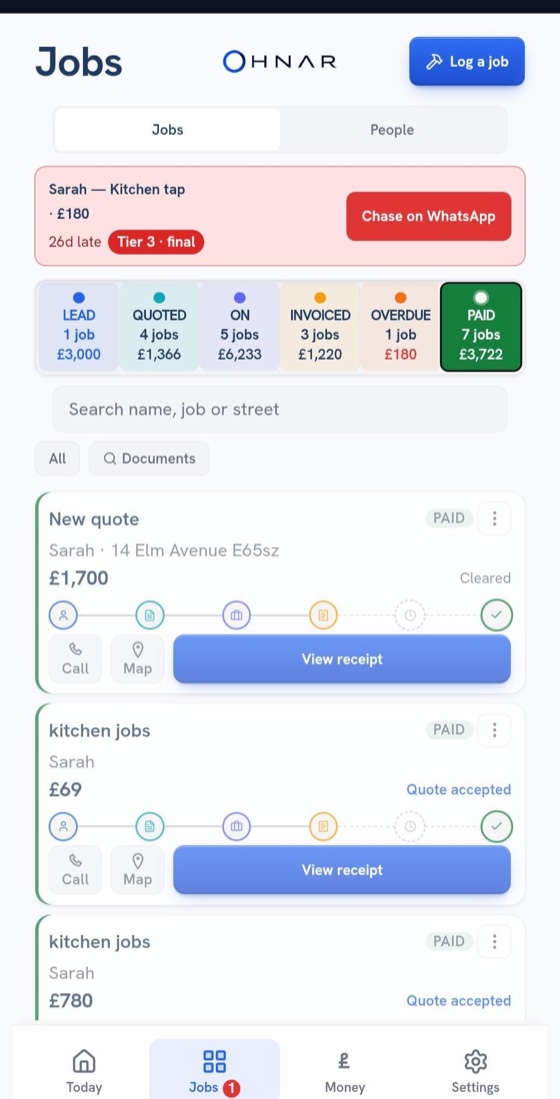
OHNAR follows the whole job: lead, quote, accepted, active, invoiced, paid — and the number that matters, actual job profit. Fast (voice-assisted, multilingual) entry, quotes and invoices with PDF export, partial payments, receipt capture and expenses, WhatsApp invoicing and reminders, overdue tracking.

The discipline is restraint: help someone run the job and get paid without making them feel like an accountant. It's live, and being refined with feedback from working tradespeople.

What it took
Payment workflowsMobile UX Voice & multilingual inputPositioning MonetisationBrand
OHNAR's job pipeline on a phone — jobs across Lead, Quoted, On, Invoiced, Overdue and Paid, with per-job cards, a WhatsApp payment chase and Call/Map actions
ohnar.co.uk
05Internal innovation · Training

Walk Coach

A route that teaches you the walk — step by step — the first time you deliver it.

New and reserve postmen get put on unfamiliar walks and are expected to just know: where to park, which bundle to open, which side to work, where to cross, and when to head back to the van. Most systems track the delivery without ever teaching the walk.

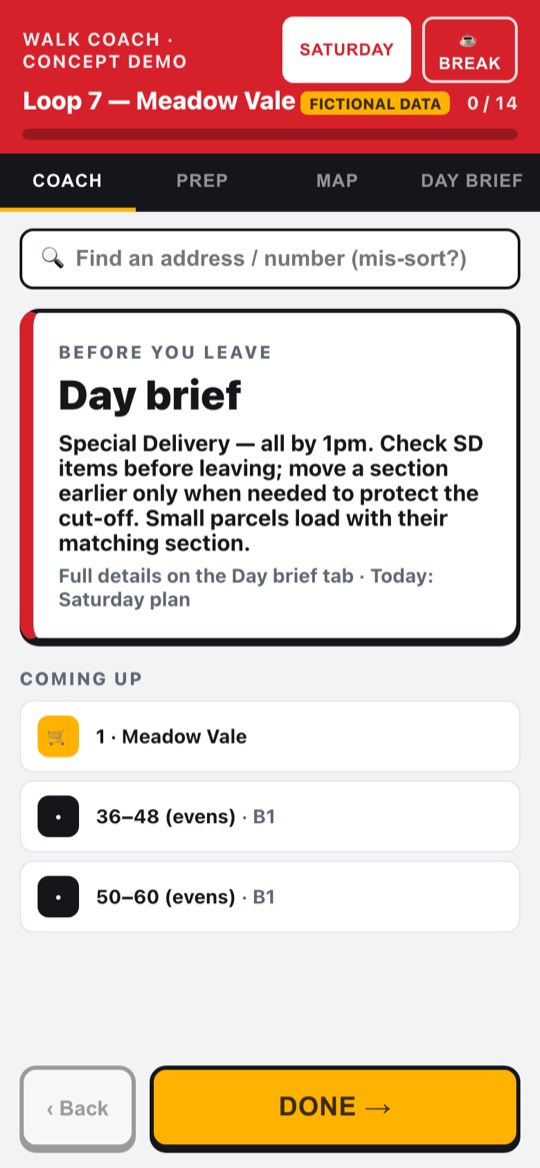
Walk Coach is a working interactive prototype: step-by-step guidance with map and coach views, next-stop prompts, bag/bundle/section indicators, loop progress, parcel and signature flags, safe-place and access notes, road-crossing guidance and break tracking.

It came straight out of the round. Early conversations with people who plan and manage routes have been positive, and it's opened up where that thinking could go next.

What it took
First-hand domain knowledgeOnboarding design Route & workflow UXOperational problem-solving
Walk Coach prototype on a phone, showing the day brief and upcoming stops on a delivery loop, with demo data
Interactive prototype · demo data

Walk Coach is an independent prototype — not affiliated with, or endorsed by, Royal Mail.

How I build

The same loop, every time
01

Notice

Spot a problem that other people have quietly accepted as normal.

02

Ask

Speak directly to the people living it — not around them.

03

Find the workaround

Understand what they do now: paper, memory, spreadsheets, WhatsApp, improvised systems.

04

Build the simplest useful version

Not the biggest — the one that changes the behaviour that matters.

05

Put it in front of real users

Ship it early enough to learn something true.

06

Learn and improve

Watch what people actually do, then make it better — quickly.

A product builder whose ability became visible because he kept solving problems wherever he found them.

About Alan

I didn't begin with a technical title. I began with problems I couldn't stop noticing — as a parent, on the round, in conversations with people trying to do their job better.

Most of this was built around full-time work and family life: before early Royal Mail shifts, after physical days, and late at night. Not in perfect conditions — through discipline and persistence.

Being a postman isn't the thing I'm escaping. It's where a lot of this came from: real communities, real operational problems, and the habit of noticing how work actually happens.

I use modern AI-assisted tools to move quickly from insight to working product. The tools are fast; the product judgement, the direction and the decisions are mine.

Now

What I'm working on
OHNAR

Live — getting it in front of more tradespeople and refining from their real jobs.

referyourpatient

Live — working with referral-led practices on what to build next.

Walk Coach

Gathering feedback on the prototype and where it could be useful next.

DC Translator

Testing the MVP with a data-centre engineer to see what's most useful.

This section is meant to stay current — Alan, tell me what to change and I'll keep it honest.

Get in touch

If you're solving a real problem, I'd like to hear about it.

Open to product opportunities, internal innovation roles, partnerships, pilot organisations, and thoughtful conversations. Not chasing quick freelance work — interested in problems worth building for.

Product rolesInnovation & ops PartnershipsPilotsJust a conversation